

Bill Belichick Has Been Here Before. Can He Find His Way Back?
Few coaches in sports have reinvented themselves the way Bill Belichick has. Every defining chapter of his career has followed the same pattern: doubt, adjustment and success. From an unsuccessful first stint with the Cleveland Browns to building the greatest dynasty in NFL history with the New England Patriots, Belichick has repeatedly proven that early setbacks do not define his legacy. Now, at North Carolina, the question isn't whether he's one of football's greatest coaches—it's whether he has one more remarkable reinvention left.
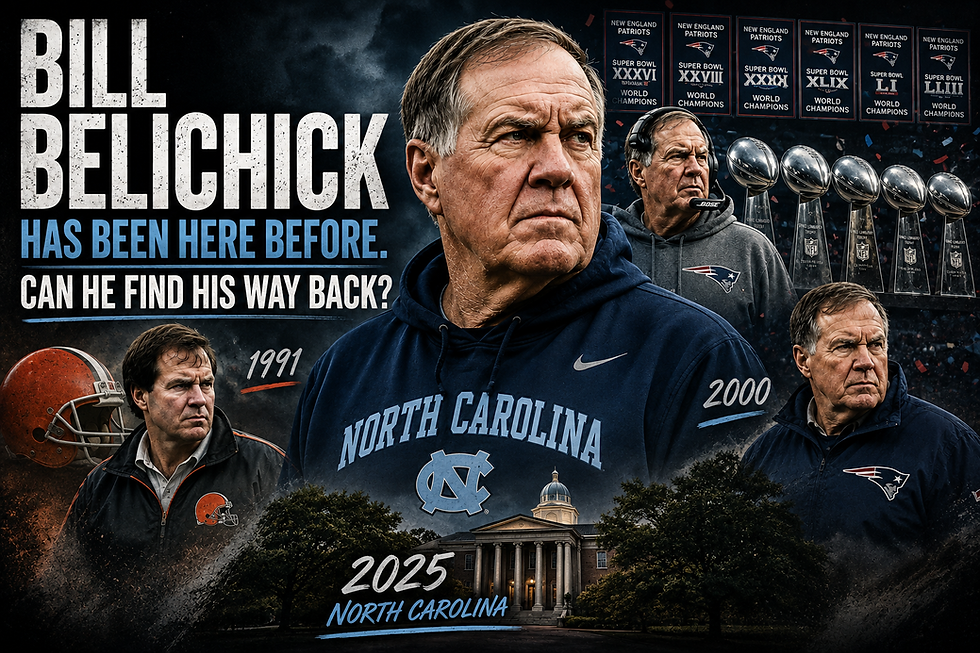
The First Opportunity
Bill Belichick's career has always been defined by reinvention. Long before he became the architect of the greatest dynasty in NFL history, he was a coach trying to prove he belonged. His first opportunity as an NFL head coach came with the Cleveland Browns in 1991 after helping build the New York Giants into a championship contender as one of football's brightest defensive minds.
Belichick's time in Cleveland was complicated. The Browns improved defensively and reached the playoffs in 1994, but the team struggled to find consistent success. His demanding coaching style created friction within the organization, and after five seasons, Cleveland moved in another direction. When Belichick was dismissed following the 1995 season, he left with a reputation as a brilliant football mind who had not yet figured out how to lead a franchise. Those questions followed him all the way to New England.
Building a Dynasty
After rebuilding his reputation as an assistant under Bill Parcells and spending time with the New York Jets, Belichick became the Patriots' head coach in 2000. Within a few years, every doubt surrounding him had disappeared. New England won its first Super Bowl following the 2001 season and began a run of dominance unlike anything the NFL had seen.
Over the next two decades, Belichick built a football operation centered on preparation, adaptability and finding small advantages that separated winners from everyone else. The Patriots won six Super Bowl championships, appeared in nine Super Bowls and became the league's gold standard. Their success came from an ability to evolve. Some seasons they relied on dominant defenses, others on special teams, power running games or Tom Brady's precision through the air. Each year brought a different challenge, and Belichick consistently found a different answer.
Life After Brady
Eventually, every dynasty reaches the same crossroads: replacing the pieces that made it possible. For New England, the most important piece was Tom Brady.
When Brady left for Tampa Bay after the 2019 season, Belichick faced the challenge every legendary coach eventually encounters—proving the system could survive without the player who had defined it for two decades. The early returns were encouraging. The Patriots finished 7-9 during a transition year with Cam Newton before returning to the playoffs in 2021 behind rookie quarterback Mac Jones and one of the NFL's top defenses. For a brief moment, it appeared Belichick had found another blueprint for success.
That optimism didn't last. The offense struggled to establish an identity, the quarterback position remained unsettled and personnel decisions that once seemed calculated began drawing heavy criticism. The franchise that had spent years solving problems suddenly found itself searching for answers. The Patriots didn't collapse overnight. They gradually transformed from perennial Super Bowl contenders into a team in need of a rebuild, and after a disappointing 4-13 season in 2023, Belichick and the Patriots parted ways, ending one of the most successful coach-franchise partnerships in sports history.
A New Challenge
Most legendary NFL coaches spend retirement reflecting on what they've accomplished. Belichick chose something different.
When he accepted the head coaching position at the University of North Carolina, he stepped into a completely different version of rebuilding. College football presents challenges the NFL never did. Recruiting, NIL, the transfer portal and constant roster turnover have fundamentally changed how successful programs are built. North Carolina is betting that Belichick's organizational structure, NFL experience and championship pedigree can provide an edge in a rapidly changing college landscape.
The questions surrounding Belichick, however, are familiar. Can his attention to detail and organizational structure translate to the college game? Can a coach known for demanding precision from veteran professionals connect with young players? Can his approach adapt to a sport that continues to evolve at an unprecedented pace?
One More Reinvention?
History suggests Belichick has never been defined by his first attempt. His career was built on evaluating mistakes, adjusting and creating something better. That was true after Cleveland. It was true when he took over the Patriots. It may be true again at North Carolina.
Belichick has already secured his place among football's greatest coaches. Six Super Bowl championships, countless playoff victories and one of the most successful dynasties in professional sports have ensured that. Now he faces a different challenge—not proving what he has already accomplished, but discovering whether he can build something great one more time.
The question at North Carolina is whether the coach who spent his career adapting to the game can adapt one final time.


Comments